Coronavirus

New support measures announced in September 2020

September 28, 2020

New support measures announced for company directors by the Government.

A series of new measures were announced today by Rishi Sunak, the Chancellor, aimed at providing businesses more support during the ‘long winter’ ahead. We are currently analysing what these new measures mean for all our clients and as more details emerges we will update you on what it means for your business.

More time to repay loans 

These measures are helpful to the firms who have managed to trade through the crisis so far but were getting increasingly worried about repaying the fresh debt taken on in the form of Government support.

Entrepreneurs who took out bounceback loans or CBILS will welcome the increasing flexibility of repayments. The ability to reduce the monthly payments by spreading it across a further four years (up from six years) will certainly help the cashflow situation of many SME’s.

Further VAT deferrals

Many SME’s deferred their VAT bill and the opportunity to spread the repayment of this (due in March 2021) throughout next year will be snapped up by many business owners who should be planning to focus on cashflow during the winter months as the furlough scheme dries up.

New ‘Job Support Scheme’  

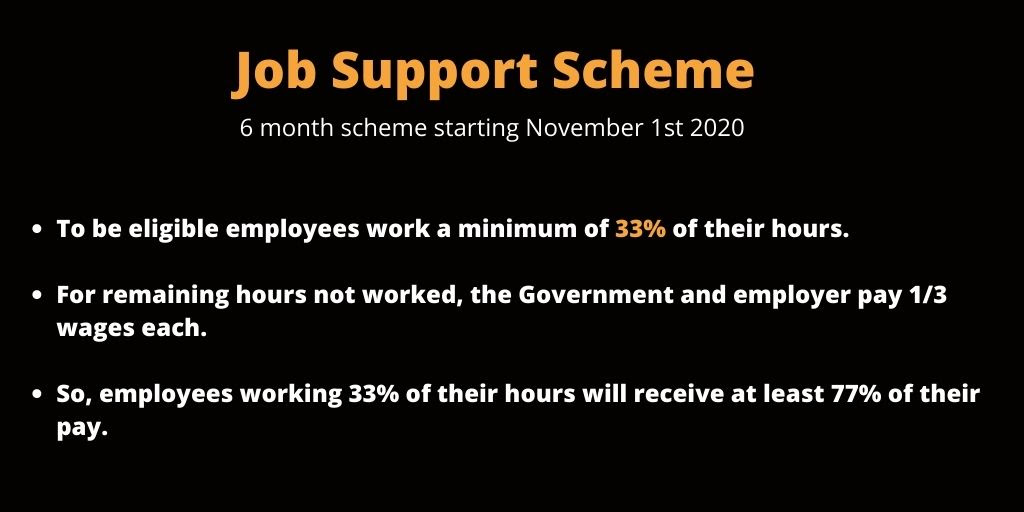
Unfortunately, the new Job Support Scheme, which we are dubbing the “little brother of furlough”, is merely marginal support for companies who are still trading. Firms who have not been trading during the past few months will find no solace in this scheme and stand to gain very little. Put simply it looks like this:

It is important that if you are making claims under the new scheme you calculate the amount you can claim accurately. If you need support to make your claim – email Murray Patt now.

And finally…

Around 11 million self-assessment taxpayers will be able to benefit from a separate additional 12-month extension from HMRC on the “Time to Pay” self-service facility, meaning payments deferred from July 2020, and those due in January 2021, will now not need to be paid until January 2022.

We are awaiting further details of this particular scheme to see of this applies to all our clients.

If you wish to discuss in more detail what these new measures mean for you and your business – please contact us now.

How to get a ‘bounce back’ loan

May 21, 2020

If you are looking for a small business loan (up to a maximum of £50,000) you may wish to consider the  ‘bounce-back’ loan scheme launched by the Government.

The scheme is specifically designed to help smaller businesses and may be more appropriate than some of the other ‘loan’ initiatives launched by the Government recently.

What we know so far: 

This may be suitable for your business if you require funding up to £50,000.

You can read more about the scheme here.

How to ‘furlough’ employees and company directors

April 6, 2020

We are guiding many clients through the process of ‘furloughing‘ employees. In addition, as we have previously indicated, company directors are also eligible to be furloughed – and we are guiding our clients through this process too.

An update has been made by the Government to the Job Retention Scheme (or ‘80% scheme’) which you can see here and officially confirms:

The information required by an employer in making a claim on the HMRC portal is:

There are still some questions that the update doesn’t answer. Specifically, these are:

Do you need more help in furloughing staff?

We are looking at launching a new specific service to help clients make their furlough claims in the correct way. If this is of interest please email Murray Patt now so that we can assess the level of demand – and then provide the necessary resource in-house to support you.

How to claim your VAT deferral

April 1, 2020

VAT payments due before the end of June 2020 can be deferred until March 2021.

This is an automatic offer with no applications required. Businesses will not need to make a VAT payment during this period

Please remember that the deferred VAT payment will eventually need be paid on or before 31 March 2021 – and VAT returns should be processed as normal.

VAT refunds and reclaims will be paid by the Government as normal.

Cancel your direct debit

However: whilst HMRC does not require you to make a VAT payment – if you pay by direct debit (and  many businesses do) YOU SHOULD CANCEL YOUR DIRECT DEBIT TO ENSURE THAT HMRC DOESN’T AUTOMATICALLY TAKE PAYMENT. 

Murray Patt says:

Many of our clients plan to make use of this VAT deferral in order to conserve cash in their business.  We are keen to remind everyone who is doing so to cancel their direct debit to avoid payment being taken.

If you have any further queries about the coronavirus VAT deferral scheme speak to Murray Patt on 0161 980 8788.

More clarity about how the ‘80%’ scheme works

March 27, 2020

We’ve been closely monitoring the support being made available by the Government. In particular, we’ve been keen to get more details about the Job Retention Scheme (often referred to as the ‘80%’ scheme).

Further details on this particular scheme are now available directly here.

Key issues

The main aspects of the scheme which are most relevant to you (based upon our review of the rules and feedback we’ve received from the clients we have been discussing this with in detail) are as follows:

If the employee has been employed for less than a year, you can claim for an average of their monthly earnings since they started work.

This is a very rapid piece of legislation and is consistent with the Governments initial announcement. The main issue still not resolved is the timescale from submission of a claim to payment. Be assured that we will keep monitoring the situation and share key details and updates as they emerge.

If you require specific advice and support to implement this scheme in your business please speak directly to Murray Patt.

How to implement the ‘80% of salary’ ‘Job Retention Scheme’

March 25, 2020

In these challenging times and with many businesses looking for answers to questions about the Government backed support, the following information, which relates to payroll & staff costs, may be useful to you:

Support for Businesses through the Coronavirus Job Retention Scheme

 What costs can employers recover?

What do employers need to do?

Does the employer have to top up the employee’s pay to 100%?

What about employees that have already been dismissed or taken unpaid leave?

What situations will this not help with?

Support for Businesses who are paying sick pay to employees

All small and medium-sized businesses and employers will be able to reclaim Statutory Sick pay (SSP) paid for sickness absence due to COVID-19.

The eligibility criteria is as follows:

Further information is being provided by the Government regularly and you should keep up to date with these fast moving developments.

If you have any questions please do not hesitate to contact Murray Patt, or a member of my team – we are all working remotely, fully operational and we are available to speak with you.

Supporting our clients

March 19, 2020

Murray Patt, our founder, is focused on supporting clients in this challenging period:

“Over the last few weeks we have all been shocked with how coronavirus has had an impact on our respective businesses.

“Whilst we are all in unchartered territory I have some basic rules for you to consider, in trying to get through this period. It may be that not all of these are relevant to you, but there will be some aspects which will help you to think clearly going forward.”

My top-ten-tips are as follows:

  1. “Cash is king”. Businesses do not fail through making losses – they fail when they run out of cash.
  2. Forecast your cashflow. Predict your future cashflow as best you can, & schedule this out using excel/similar tools. I recommend doing this for a 12 week period & monitoring it daily vs actual.
  3. Cash injection. Be prepared to inject monies into your business & talk with your bankers at an early stage for support.  Through fundingcircle.com our clients can secure a discount on standard loan rates, with a rapid decision-making process.
  4. Government loan/grant schemes. Whilst these schemes are very welcome, it will take time for them to get up & running – therefore do not rely on them. Further, if they are administered by the banks/local authorities, who are already struggling for staff, then expect them to be slow & cumbersome.
  5. Loan repayment holidays. Talk with your funder(s) & see if you can arrange a payment holiday on your existing loans.
  6. Employment contracts. Review your staff contracts, & see what scope there is to make changes & save cost. However, please consider the knock-on effect on them.
  7. Paying suppliers. Talk with them &, if you can, agree revised terms in the short-term.
  8. Be selective with cancelling discretionary expenditure. We will eventually come out of the other side of this, & therefore do not terminate arrangements now, which you may regret in a few months time.
  9. Plan in advance. If some form of restructuring to your business is required, then the sooner you take some professional advice the better.
  10. Talk, talk, talk. Don’t be afraid to talk with us, & other business owners. The more we share our experiences the better for everyone.

Murray Patt says:

I suspect that things will get worse before they start to improve again, but they will improve – the uncertainty is the timescale for this. The team at AK&Co are there to support you & we will always make time to speak with you. Every day is a steep learning curve, & we will get through this eventually.